
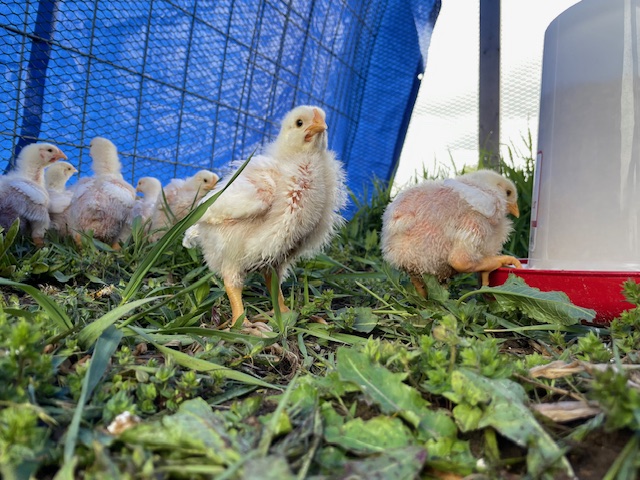
There are so many benefits to raising your broilers on a pasture. In this article we are going to outline some of the numerous advantages of raising broilers in our chicken tractors and also go over some of the disadvantages as well.
Our broilers are raised in what we call a brood box until they are about 2-3 weeks of age. During this time they have a heat lamp on them constantly. If you’ve ever raised broilers before, you know that by the second week they are outgrowing the brooder and are ready to be moved to a larger area. One of the few things we check before moving the chicks outside is making sure that the lows are consistently above 55 degrees, and the chicks have most of their feathers. We then move them into what we call a chicken tractor. A chicken tractor is a temporary structure that can be moved around easily, allows for the broilers to have access to the ground, and protects them from predators. Our tractors are made from cattle panel and poultry netting primarily. (If you are interested in learning how we built our chicken tractors and a cost breakdown, subscribe so you don’t miss when we post it!)
When our broilers are out in the tractors we rotate them every 3 days to every day depending on how big they are and how many chickens that are in the tractors. One of the biggest pros about raising your broilers in these tractors and on a rotation is that they naturally fertilize the ground. I have seen tractors that go over raised beds and they will rotate the birds through the different beds as a way to naturally fertilize for the next years crops. I’ve always noticed how grass grows back greener where ever our chickens have been.
In addition to fertilizing the ground that they’re on, rotating broilers through a pasture or garden improves the birds quality of life. It allows the animals to forage for bugs, pick and scratch at the ground. They have the freedom to move around and constantly have access to fresh ground. This is one of the biggest driving factors for why we rotate our broilers outside. I truly believe that the least you can do for an animal that is intended to feed you, is to give them the best possible life. Part of that is giving them the space to be a normal chicken.
Not only do you give your broilers a better quality of life and get free fertilizer out of raising them outside and on pasture, you also spend less money on feed. When you rotate the birds through a field, they pick at the grass, eat insects, maybe even eat left overs from your garden. This means you are spending less money on buying a commercial feed, and that can add up quickly!
More and more people are turning towards more locally grown food and healthier food options. Did you know that pasture raised chicken has been proven to be healthier than conventionally raised chicken? Pastured chicken is lower in sodium, cholesterol, calories and fat. In addition, it’s higher in omega fatty acids and vitamin A.
There is no doubt that rotating broilers on pasture is a fantastic way to go about raising these animals but there are a few disadvantages. Here in New Hampshire, our growing season is really short. Broilers specifically do not do well in the colder weather (below 55), especially when it’s rainy or wet. In 2023, we lost so many broilers due to the fact that the rain just did not let up and the summer was a lot cooler. Because of our seasons here, I would only recommend raising broilers outside between the months of May and September for the best yield and quality of life.
The Goat Farm prides itself on raising pasture raised chicken. Not only are the birds happier, you get healthier meat that just taste better. Pre-orders are available now for our pasture raised whole chickens, email thegoatfarmnh@gmail.com to reserve yours now!
 THE GOAT FARM
Leave a comment