
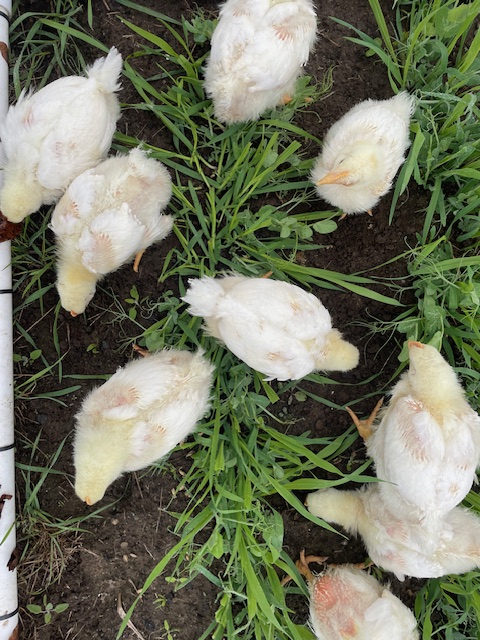
If you know of the breed Cornish Cross, you’ve probably heard people call them “disgusting” and “filthy”. People say these birds live in poor conditions, with horrible health conditions. While this can certainly be true for some commercial farms, the industry has come an incredible way in addressing these issues. In addition, a lot of small homesteads and farms also raise these birds with no issues, myself being one of them. Personally, I have found them to be relatively clean depending on how you manage these birds.
Cornish Crosses are the large meaty chickens you see in the grocery, but our chickens didn’t always look like that. About a hundred years ago, a woman named Celia Steele decided she was going to start raising meat birds to make some extra money at the market. In 1923 her flock had grown to be around 500 birds, and 3 years later she opened the first 10,000 bird broiler house. This started a chain of events that drastically changed the poultry industry.
In 1948, owner of Arbor Acres Farm, Henry Saglio, won the national competition for the best meat bird with a white Plymouth Rock. He won again in 1951, beating Vantress Hatchery both times. These 2 hatcherys would eventually emerge with the most dominant genetic stock of Cornish Crosses in the US. Today, there are 2 main strains of Cornish Cross but most hatcheries and large operations have their own genetic differences. The 2 strains are Ross 708 and Cobb 500.
The Ross 708 or commonly called the Cornish Rock was developed by Arbor Acres Farms. Their chickens are white, have yellow skin and feet. These birds typically put on the most weight between weeks 4-8. This later weight gain allows their frames to develop more. This strain is now owned by Aviagen.
The Cobb 500 or commonly called the Jumbo Cornish Cross was developed by the Vantress Hatchery. Their chickens have yellow feet and skin and white feathers that sometimes can have specks of black. These birds evenly put on weight from beginning to end, with an emphasis on large breasts. This strain is now owned by Tyson.
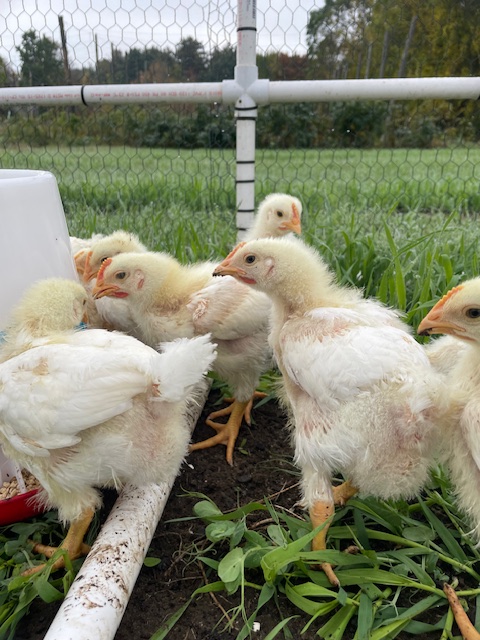
All Cornish Crosses have been bred to utilize feed efficiently and put on muscle fast. To put it into perspective, in the 1920’s “meat birds” would take 16 weeks to reach a market weight of about 2.5lbs. Today, Cornish Crosses reach a market weight of 5-7lbs in about 8 weeks. This does not come without its downsides. These birds are unable to reproduce. If Cornish Crosses are not processed at the 8 week mark, they will die. Because their bodies put on weight so fast, their bones don’t have enough time to develop properly. Meaning their legs can’t bear the weight of their body and can break. Another issue is that their hearts can easily give out, trying to pump blood through all of the muscles.
So why raise these birds? There is no getting around the efficiency of the Cornish Cross. While they reach market weight in 8 weeks, there are other breeds of broilers that don’t reach market weight until week 10-12. Because the margin on farming in general is so small, it’s incredibly hard for farms to justify raising a breed of chicken that takes an extra 4 weeks to reach a weight that is still less than that of the Cornish Cross. In addition, the amount of feed that bird will eat in the extra 4 week, if not overall. To put it simply, it isn’t economical.
Cornish Crosses are a fantastic option if you want to raise large meat chickens for your freezer. They are without a doubt the most economical breed. If you are interested in learning about other broiler breeds, subscribe to our website to be the first to see new posts on breeds, our animals and other farming topics.
 THE GOAT FARM
Leave a comment