
Goats are social and active creatures, requiring ample space in order to live happy and healthy lives. If you are looking into raising goats, they will need a shelter and paddock or pasture where they’ll be housed. There are a lot of great resources out there to look at when designing your barn and paddock for your goats that it can easily become overwhelming when it doesn’t have to be.
According to UNH Extension, they recommend that each goat has between 20-25 sqft of space for indoor housing. Other universities recommend anywhere from 16-32 sqft per goat. These large ranges depend on what breed of goat you plan on raising. Nigerian Dwarf goats require less space than a Nubian or Boer. These are just guidelines but a good rule of thumb is to always go bigger. If you are planning on bringing home 3 mature does, they’d need approximately 75 sqft of indoor housing according to UNH’s Spacing Guidelines. If you plan on breeding your does, that’s another 6 animals that could come from those does.
The numbers above do not include outside space for the goats. According to UNH Ext. they recommend 50 sqft of space per goat. An outside area is different than a pasture. Pasture is considered a space where the animal can graze and gets the majority of their food from what they graze. Where as an exercise area or outdoor space is where goats can hang out, play and have access to stored forage like hay. No option is better than the other. As with the indoor housing, going bigger is always better. When I first started raising goats, I had a 2,500 sqft area for my 3 Nigerian Dwarf goats. By these requirements that was an extra 2,350 sqft for my animals.
In addition to making sure your goats have enough outdoor space, they need enrichment. Goats love to climb and jump on things. Because goats are prey animals by nature, they like to be higher up so that they can see their surroundings better in case of any danger. Adding some structures that they can jump on goes a long way for their well being.
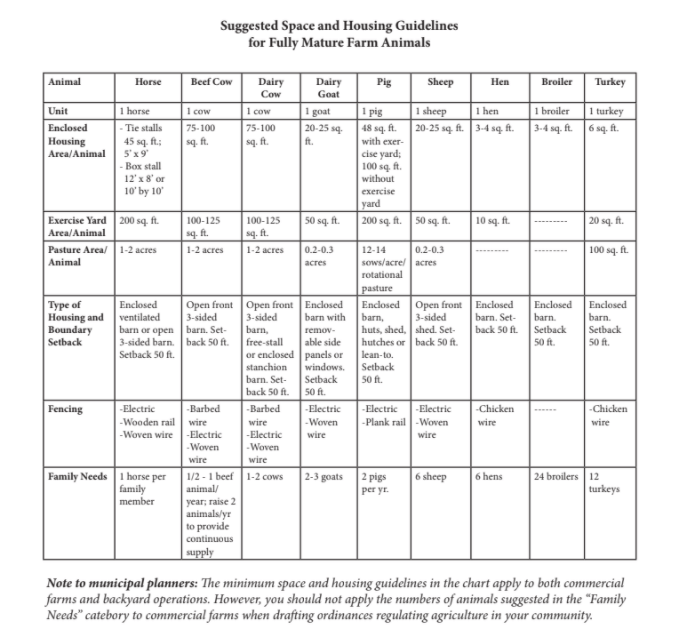
This chart is from UNH Extension’s Housing and Spacing Guidelines for Livestock.
No matter what your final design for your goats housing area looks like, giving these animals the most space you can will only benefit you and them in the end. Happy and healthy goats produce more milk and more meat than goats kept in more crowded conditions. As stated before, these are just guidelines and should be used a starting point. If you have any questions about the spacing guidelines, check out UNH Ext. website for more info!
 THE GOAT FARM
Leave a comment